
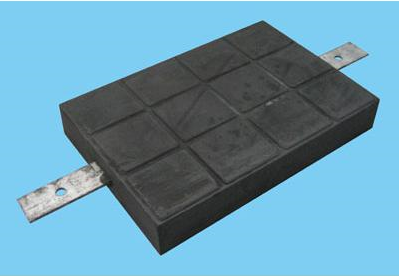
Flat Grounding Module
Title: Flat Grounding Module, Switchgear Grounding Module, High-Voltage Transmission Line Grounding
Keywords: Superconducting Corrosion-Resistant Grounding Module, High-Content Grounding Module, New Grounding Module, Power Plant Lightning Protection Grounding, Substation Lightning Protection Grounding, Electrified Railway Lightning Protection Grounding, Telecommunication Base Station Grounding, Mobile Communication Base Station Grounding, Microwave Relay Station Grounding, Ground Satellite Receiving Station Grounding, Radar Station Lightning Protection Grounding, Precision Instrument Lightning Protection Grounding, Computer Room Equipment Lightning Protection Grounding, Postal and Telecommunications Program-Controlled Equipment Lightning Protection Grounding, Radio and Television Equipment Lightning Protection Grounding, Electronic Medical Equipment Lightning Protection Grounding, High-Rise Building Lightning Protection Grounding, Famous Historical Building Lightning Protection Grounding, Tall Memorial Tower Lightning Protection Grounding, Oil Pipeline Lightning Protection Grounding, Oil and Gas Tank Lightning Protection Grounding, Flammable and Explosive Material Warehouse Lightning Protection Grounding
Temperature: -40℃~80℃
Buried Depth: >0.8m
Module Spacing: <3m
Product Certification: ISO9001:2000
Protection Rating: IP64
Explosion-proof Function: None
Application: Lightning protection grounding
Operating Environment: Any environment
Technical Specifications:
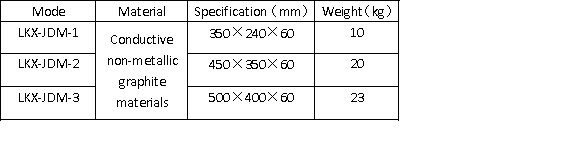
Model: LKX-JDM
Specifications:
(Flat, 10kg)
(Flat, 20kg)
(Flat, 23kg)
(Square, 20kg) (Round, 20kg)
(Electrolytic Ionizing, 10kg)
Dimensions:
Flat, 10kg: 350×240×60mm
Flat, 20kg: 450×350×60mm
Flat, 23kg: 500×400×60mm
Square, 20kg: 480×170×120mm
Round, 20kg: Φ150×800
Electrolytic Ionizing, 10kg: 500×200×55
Resistivity at room temperature: ≤3Ω·m
Power frequency grounding resistance: 8.2Ω (soil resistivity is taken as 52Ω·m for typical suburban soil in Changsha).
Estimation formula: Rj≈0.16ρ (Rj is the grounding resistance of a single module; ρ is the soil resistivity).
Product Application:
The LKX-JDM flat 10kg grounding module is a grounding electrode mainly composed of conductive non-metallic materials. It consists of non-metallic materials with good conductivity and chemical stability, a metallic grounding electrode, electrolyte, and a hygroscopic agent.
Working Principle:
The Leibaihui grounding module contains stable conductive components, metal passivating corrosion inhibitors, water-retaining agents, etc. Buried underground, it can make close contact with the soil, expanding the current dissipation cross-sectional area and forming a low-resistance area with a gradual change in resistivity underground, thus significantly reducing the grounding resistance of the entire grounding grid.
Product Features:
1. This module uses a stable non-metallic conductor material as its conductive medium, and its conductivity is unaffected by the season.
2. It can absorb and retain moisture, maintain effective contact with the soil, and has low grounding resistance.
3. In areas with high soil resistivity, it can effectively reduce the grounding resistance of the grounding grid.
4. It can withstand high power frequency and impulse current surges, and its resistance is stable.
5. It is corrosion-resistant, non-toxic, has a service life of up to 30 years, and is easy to install.
6. It can withstand temperatures as low as -40 degrees Celsius, making it suitable for cold northern regions as well.
Usage Calculation:
Based on years of practical experience in constructing grounding grids using grounding modules in different regions and industries, and combined with scientific grounding grid resistance reduction theory, the following formula for calculating the usage of grounding modules is summarized: n = K·ρ/(Rn·η). The result is rounded to the nearest integer.
Where: n—Number of grounding modules.
ρ—Soil resistivity.
K—Module grounding coefficient, ranging from 0.11 to 0.16; the higher the soil resistivity, the smaller the value of K.
Rn—Grounding resistance value required by the grounding grid design.
η—Grounding module utilization coefficient, ranging from 0.6 to 0.9; the more modules, the smaller the value of η.
Construction Method:
1. Grounding modules should be buried according to design requirements, either vertically or horizontally. The burial depth should not be less than 0.8 meters.
2. To reduce mutual interference between grounding modules, the burial spacing should ideally be no less than 3 meters; in special cases, the spacing can be appropriately reduced.
3. When module cores are connected in parallel or to the ground wire, welding is mandatory. The weld length should be at least twice the width of the connecting body.
4. Weld slag should be removed from the welded areas, and anti-corrosion conductive paint or asphalt paint should be applied.
5. Backfill soil should be appropriately watered, compacted in layers, and the grounding resistance measured after the modules have fully absorbed moisture (24 hours).
Precautions:
1. Modules should be stored in a certain humidity level, avoiding high temperatures, dryness, and direct sunlight.
2. During transportation and installation, avoid mechanical damage to the modules.
3. In cold regions, modules should be buried below the frost line.
Main applications:
1. Working grounding, safety grounding, and lightning protection grounding for power plants, substations, switching stations, high-voltage transmission lines, electrified railways, telecommunications and mobile communication base stations, microwave relay stations, ground satellite receiving stations, radar stations, etc.
2. Working grounding and protective grounding for valuable precision instruments, computer room equipment, postal and telecommunications program-controlled equipment, broadcasting and television equipment, electronic medical equipment, etc.
3. Lightning protection grounding for various high-rise buildings, scenic spots and ancient buildings, tall memorial towers, etc.
4. Lightning protection grounding for oil pipelines and oil and gas tanks, and warehouses storing flammable and explosive materials.