
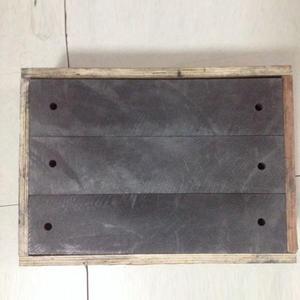
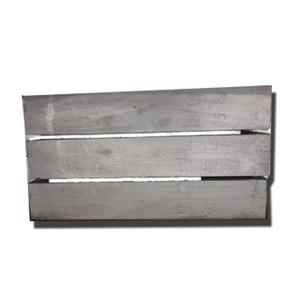
Rectangular fired grounding module
Title: Rectangular Sintered Grounding Module, Physical Grounding Module, Lightning Protection Grounding System
Keywords: Gas station grounding module, low-resistance sintered module, graphite grounding module, power lightning protection grounding, mobile communication lightning protection grounding, high-speed rail lightning protection grounding, new energy lightning protection grounding, petroleum and petrochemical lightning protection grounding, military lightning protection grounding, educational lightning protection grounding, ancient building grounding device, water conservancy grounding device, environmental protection grounding device, coal grounding device, computer room grounding module, building grounding module, bridge grounding module

Temperature: -40℃~80℃
Buried Depth: >0.8m
Module Spacing: <3m
Resistivity at Room Temperature: ≤4.0Ω.M
Power Frequency Grounding Resistance: 1.5Ω
Product Certification: ISO9001:2000
Protection Rating: IP64
Explosion-proof Function: None
Application: Lightning protection grounding
Usage Environment: Any environment
The fired grounding module is currently the best grounding electrode on the market, featuring long life, no pollution, high lightning discharge capacity, and no deformation. It is made from flake graphite with a purity of over 99%, processed through several steps including water washing, acid washing, and drying, and then fired at a high temperature of 1400 degrees Celsius.
The module uses non-metallic conductive materials as its main body, with low conductivity and stable performance. It does not degrade when buried in soil, contains no corrosive ions, has a long service life, and is safe and environmentally friendly. This product has a unique process, high compressive strength, and holds a patent certificate; its comprehensive performance indicators are among the best in China.
The grounding module has a significantly larger diameter than ordinary steel grounding electrodes, allowing for faster conduction of fault current to the ground under the same fault current conditions. Furthermore, its multi-channel distributed arrangement on the grounding electrode effectively reduces high-current surges in areas prone to lightning strikes. Due to its larger size compared to traditional grounding electrodes, the grounding area with the soil is also increased, reducing contact resistance.
After being buried in the soil, the module maintains close contact with the soil, significantly expanding the current dissipation area and effectively reducing grounding resistance. The module’s unique moisture-retaining and hygroscopic properties keep the surrounding soil with low resistivity, further improving the conductivity of the grounding electrode.
Technical Parameters:
1. Bulk density not less than 1.68 g/cn³.
2. Resistivity not greater than 8.5 μΩ·m, equivalent to a good metallic conductor (stainless steel, pure copper, etc.), which is beneficial for constructing a high-quality grounding grid.
3. Ash content not exceeding 0.20%
4. Compressive strength not less than 30MPa, allowing for thorough compaction during grounding grid construction and improving the discharge of large surge currents!
5. Flexural strength not less than 13.5MPa, suitable for grounding grid construction.
6. Elastic modulus not exceeding 10.0CPa.
7. Thermal conductivity (100℃) not less than 90W/(m·K)
8. Coefficient of thermal expansion (room temperature to 600℃) not greater than 2.8 × 10⁻⁸/℃
9. Excellent water absorption and retention properties. Due to its firing process, the module is filled with numerous pores, resulting in excellent water affinity and water retention, making it particularly suitable for grounding in dry soils.
10. Pollution-free and does not alter the surrounding soil, adaptable to many special and demanding environments.
11. Packed in cardboard or wooden crates, saving on module transportation costs.
12. Long lifespan, not easily broken, with a service life of up to 50 years.
Usage Instructions:
1. Grounding modules can be installed vertically or horizontally depending on site conditions, with a burial depth generally below 0.8m-1m (the burial depth depends on site conditions);
2. It is recommended that the spacing between grounding modules be no less than 0.8m (the radius of ion diffusion is 1m-3m, depending on site geological conditions);
3. When the electrode cores of the grounding modules are connected in parallel or to the ground wire, electric welding or exothermic welding must be used. The welding length should be three times the width of the connecting wire;
4. When the internal electrode core of the grounding module is made of hot-dip galvanized steel, the weld joint should be cleaned of weld slag and evenly coated with anti-corrosion conductive paint or wrapped with grounding resistance reducing agent;
5. When backfilling the grounding module, an appropriate amount of water should be added and the layers compacted to ensure close contact with the earth. The grounding resistance should be measured after the module has fully absorbed moisture.
Features:
1. Resistivity is less than 40μΩ, equivalent to a good metal conductor (stainless steel, pure copper, etc.), which is beneficial for constructing a high-quality grounding grid. 2. High compressive strength, exceeding 20 MPa, allowing for thorough compaction during grounding grid construction and enhancing the dissipation of large surge currents.
3. Excellent water absorption and retention properties. Due to its fired manufacturing process, the module is filled with numerous pores, resulting in excellent water affinity and effective moisture retention, making it particularly suitable for grounding in dry soils.
4. Pollution-free and does not alter the surrounding soil, adaptable to many demanding environments.
5. Packaging in cardboard or wooden crates saves on module transportation costs.
6. Long lifespan, not easily broken, with a service life of up to 50 years.
7. Connections can be achieved through thermoforming welding or electric welding, facilitating construction.
Suitable Industries: Power, Mobile, High-speed Rail, New Energy, Petroleum & Petrochemical, Military, Education, Ancient Buildings, Water Conservancy, Environmental Protection, Coal Mine, Computer Room Grounding, Building Grounding, Bridge Grounding, etc.