
The island is located at:
STN 01:324628.103mE longitude 509719.05mN latitude 1377m MSL
STN 02:324,854.766mE 509,698.350mN 1,676m MSL STN 03:324,910.869mE 509,875.653mN 1,510m MSL, The total area is about 60000 square meters, and the main layout on the island is divided into office area, leisure and entertainment area, and accommodation area.
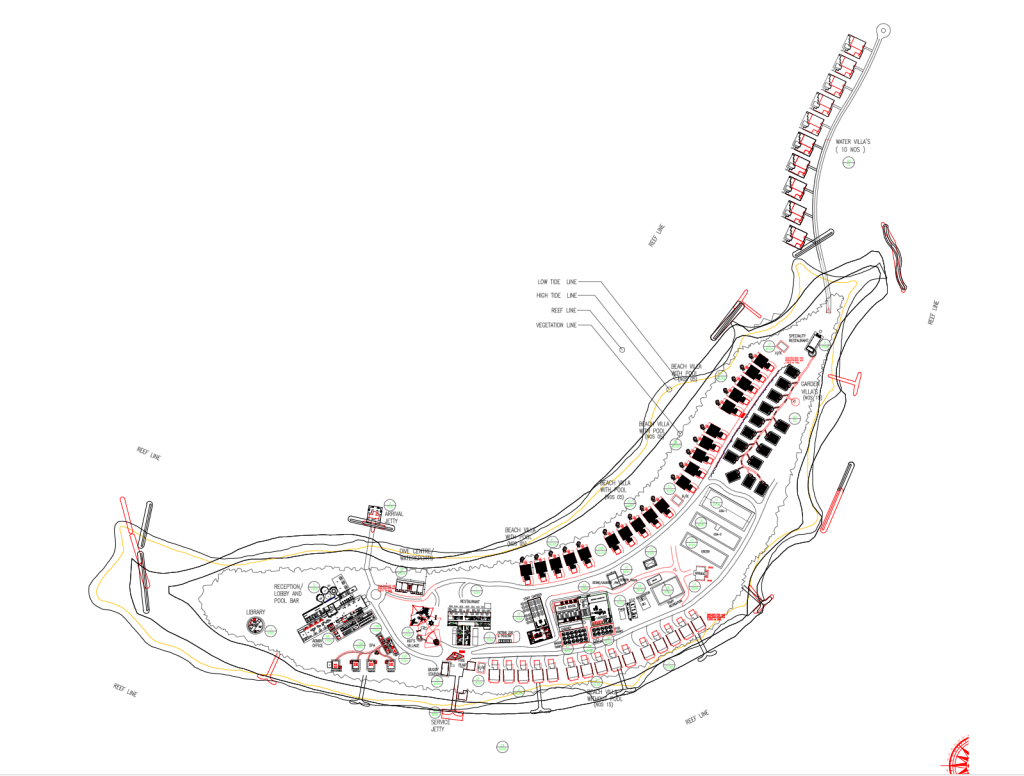
Project Overview
This project is located in the Maldives, which has a tropical monsoon maritime climate with high annual thunderstorm days and frequent lightning activity, making it one of the most destructive meteorological disasters in the area. The total area of the project is about 60000 square meters, and the main functional zones on the island include office area, leisure and entertainment area, and accommodation area. Due to its location on an island, the high soil resistivity and severe salt spray corrosion, as well as the scattered and functionally sensitive buildings, pose special challenges to lightning protection.
Design Basis and Challenges
- Harsh marine corrosive environment: High salt spray and high humidity environments have extremely strong corrosion effects on metal material lightning arresters, down conductors, and grounding bodies, greatly reducing the service life of conventional materials.
- High soil resistivity and grounding difficulties: Coral sand geology makes it difficult to meet grounding resistance standards, requiring special resistance reduction measures or new grounding materials.
- Multi regional lightning protection requirements: A large number of weak current equipment are concentrated in the office area, which is susceptible to damage from lightning electromagnetic pulse (LEMP); The accommodation area is densely populated, and it is necessary to ensure personal safety and the stability of the intelligent building system; Leisure and entertainment areas (such as swimming pools and outdoor facilities) need to be protected against direct lightning strikes and step voltage.
- Power supply stability requirements: As an independent island, power and signal lines are often introduced through overhead or buried methods, which can easily conduct lightning surges
Protection scheme design
- Direct lightning protection
Taking into account the coordination between the protection scope and the landscape, a comprehensive protection mode combining advance discharge lightning rods (ESE) and Faraday cages is adopted.
Office area: Install EPE series pre discharge lightning rods on the top of the main office building, utilizing their pre discharge characteristics to expand the protection radius of a single lightning rod, effectively protecting the rooftop communication antenna and air conditioning outdoor group.
Accommodation area: For scattered standalone villas or row rooms, metal decorative components on the building roof (such as railings and decorative frames) are used as natural lightning arresters, and reliably welded with structural steel bars to form a cage type lightning protection net (Faraday cage), which ensures both aesthetics and full coverage.
Leisure and entertainment area: For open areas such as swimming pools and outdoor restaurants, independent lightning rods (towers) should be installed, and the protection range should be strictly calculated according to the rolling ball method to ensure that personnel activity areas are within the direct lightning protection zone. - Grounding and equipotential connection
To address the issue of high electrical resistivity in coral sand, a circular hybrid grounding grid design is adopted
Material selection: The main grounding body adopts multi-layer alloy graphene composite grounding material. This material has excellent conductivity and super corrosion resistance, specially developed for high salt spray environments on islands, solving the pain point of traditional galvanized steel grounding electrodes being prone to corrosion and failure.
- Structural layout: Install closed circular grounding bodies around the buildings in each functional area, with a burial depth that meets the requirements of extremely low electrical resistivity. The grounding grids of each individual building are connected to each other through horizontal grounding strips, forming a unified joint grounding system for the entire island, effectively reducing the total grounding resistance.
Equipotential bonding: All metal pipes, cable metal sheaths, and equipment metal shells entering the building are reliably connected to the grounding system through the main equipotential bonding terminal box, eliminating the risk of ground potential rebound.
- Lightning electromagnetic pulse (LEMP) protection
Considering the extensive use of precision electronic equipment in office and accommodation areas, the implementation of multi-level surge protection device (SPD) configuration:
- Level 1 (Surge Coarse Protection): Install a Level I test surge protector (SPD) at the low-voltage incoming cabinet of the main distribution room to discharge lightning current.
Level 2 (Surge Protection): Install Level II test SPDs at the distribution boxes on each floor to further limit overvoltage.
Level 3 (Surge Fine Protection): Install Level III surge protectors or lightning protection sockets at the front end of servers in office areas, intelligent control systems in accommodation areas, and audio and video equipment in entertainment areas.
Signal line lightning protection: All communication, network, and monitoring signal lines entering the island shall be equipped with adaptive signal SPDs at the equipment ports to prevent induced lightning from entering along the lines.
- Lightning warning and intelligent monitoring
Considering that the Maldives has implemented a real-time lightning detection system, this project reserves an interface to connect to the warning network. By installing intelligent lightning counters and SPD status monitoring modules, real-time recording of lightning strike occurrence time, intensity, and lightning protection device health status can be achieved, upgrading from “passive protection” to “active operation and maintenance”, and improving emergency response efficiency under extreme weather conditions.